
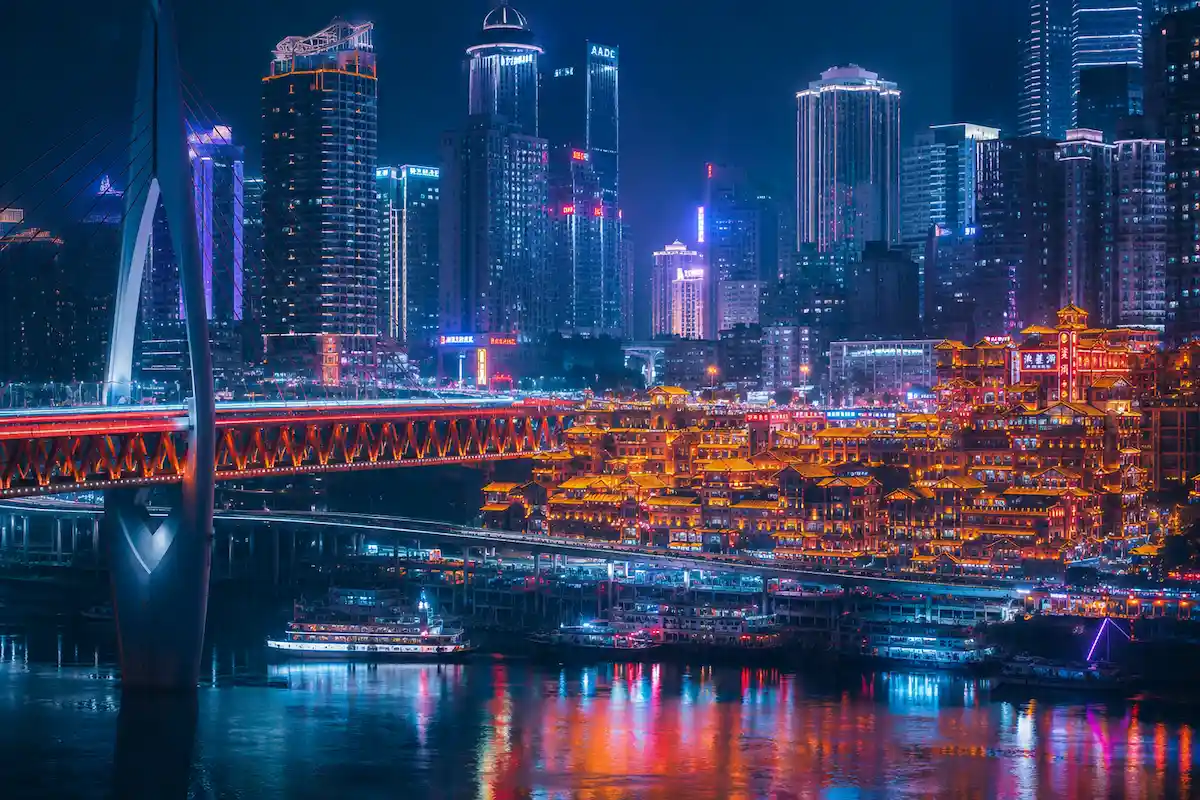
Most people skip Chongqing entirely. They fly into Beijing, hit Xi’an for the Terracotta Warriors, and add Guilin as their nature fix. That is the wrong trip. Chongqing is a vertical city where high-rises and metro lines cling to cliff faces and the streets exist on five different levels at once. At night, with the neon on and the Yangtze below, it operates like nowhere else in the world. Pair it with Zhangjiajie and you have a double hit no other one-week China itinerary can match: a megalopolis that runs like a fever dream, followed by a landscape so alien it literally inspired a Hollywood science fiction world. Zhangjiajie is booming again in 2025, with record international arrivals from the U.S., Europe, and Southeast Asia. The window to do both in a week is wide open. Use it.
Getting There
Fly into Chongqing Jiangbei International Airport (CKG). Major carriers including Air China, China Eastern, and China Southern serve CKG from most Asian hubs. Search flights on Skyscanner or Trip.com.
From Chongqing, take the high-speed train to Zhangjiajie. About 17 direct departures leave Chongqing East daily. The fastest journey covers roughly 430 km in just over two hours. That single connection makes the train the obvious choice over flying for nearly every traveler on this itinerary.
Fly home or connect onward from Zhangjiajie Hehua Airport (DYG). Domestic connections to Beijing, Shanghai, and Chengdu run frequently. Book via Trip.com.
Train: Chongqing East Station to Zhangjiajie West Station, from ¥191 (~$27) second class. Book at Trip.com.
Best time to go: Spring (March–May) brings mild temperatures of 15–25°C, blooming flowers, and misty mornings. Autumn (September–November) offers clear skies and warm days around 15–28°C with colorful foliage.
Days 1–4: Chongqing
Day 1: Land, Orient, Eat Everything
Get to Jiefangbei CBD as fast as possible. Drop your bags, shake off the flight, and walk to the Yangtze River Cableway before dinner. It runs 1,166 meters across the river and the views at dusk, with the city’s stacked skylines glowing behind you, are why people fly to Chongqing. Ride it across and back.
Tonight is your first hotpot. Go straight to Pei Jie Hotpot on Bayi Road, Jiefangbei. It is a legend. It does not hold back on the fiery mala flavor that makes this city famous. A meal runs around ¥170 per person ($23). Order the split pot your first time — half mala, half clear — and work up to the full red. Fair warning: “mildly spicy” in Chongqing is not mildly spicy.
Day 2: The Vertical City
Chongqing is not a city you check off. It is a city you get lost in. Start the day at Liziba Station on Metro Line 2. It sounds gimmicky. It is not. Stand on the platform and watch a full-size train appear through the wall of someone’s apartment building. That is the city in a nutshell.
From there, walk to the Eling Park cliff-top observation area. Lookout cafes hang above the city where you can sit for hours and watch the streets below running on multiple levels. One that offers a personal tabletop grill and a teapot runs around ¥200 per person ($27).
In the afternoon, walk to Ciqikou Ancient Town, a well-preserved district of stone alleys and Ming-era buildings about 20 minutes west of downtown by metro. It crowds up by mid-morning, so arrive early. While you’re there, look for the Chongqing 1949 performance theater nearby. It is a rotating-stage show — both the stage and the seats rotate 360° — and the whole thing runs around 70 minutes. Book on GetYourGuide or Trip.com. Tickets run around ¥200–400 depending on the section. Book the B section.

Day 3: Shibati + Underground Hotpot
Shibati (“Eighteen Steps”) was once a consulate area and a key link between Chongqing’s upper and lower city. It is one of the most underrated neighborhoods in all of China. By September 2024, all five zones of the revitalized complex were fully open. In March 2025, the Ministry of Culture and Tourism designated it a National-Level Tourism and Leisure District. Entry is free.
Walk it at night. The red lanterns light up the stone steps and the back alleys thin out the tourist traffic. Start at the top, take your time, and go wherever looks interesting. The main drag empties faster than the side streets.
For dinner, go underground — literally. Dongting Air-Raid Shelter Hotpot in Yuzhong District is the hidden gem of this entire city. The tunnels stay cool in summer and warm in winter, and the scent of beef fat fills every corner. Eating in a bomb shelter turns dinner into a story. Budget around ¥100–150 per person ($14–21).
Day 4: Dazu + The Yangtze at Night
Use your last full day in Chongqing on a day trip to the Dazu Rock Carvings, a UNESCO World Heritage Site about 90 minutes west of the city. The carvings are an exceptional series of Buddhist, Confucian, and Taoist rock sculptures dating from the 9th to the 13th century. Buses run from Chongqing’s Caiyuanba Bus Station. Round trip with entry runs about ¥150–200 ($21–28). Do not skip this because it sounds dry. The scale and artistry are genuinely astonishing.
Return to the city by late afternoon for a Two-River Night Cruise on the Yangtze and Jialing rivers. Tickets run around ¥100–150 ($14–21). The views of Hongyadong’s illuminated cliffside stilt houses from the water are the best you will get. Do it from the boat, not from inside. The stores inside Hongyadong cater to tourist traffic exclusively — prices are higher and the souvenirs are not worth it.
Day 5: Transfer to Zhangjiajie
Take an early morning departure from Chongqing East Railway Station, the new southeast high-speed hub that opened June 27, 2025, reached via Metro Line 6. Arrive in Zhangjiajie by late morning.
From Zhangjiajie West Station, it’s roughly 26 km to Wulingyuan, the gateway town for the national park. Take the tourist coach (¥12–13, 50–70 minutes) or DiDi (~¥55–80).
Check in at Wulingyuan. That is the town closest to the park entrance, not Zhangjiajie City. Staying there saves you significant daily travel. Spend the afternoon walking the town, booking your park tickets, and resting. The next two days are full.
Day 6: Zhangjiajie National Forest Park

Get to the park gate by 7:30 AM. The first shuttle to Yuanjiajie empties before the crowds arrive.
Your ticket: the Zhangjiajie Forest Park + Three Cableways and One Elevator combo. It covers entry to the Wulingyuan Scenic Area and is valid for 4 consecutive days, with unlimited park shuttle bus rides and unlimited rides on the Tianzi Mountain Cableway, Yangjiajie Cableway, Huangshizhai Cableway, and the Bailong Elevator. Cost runs around ¥225 (~$30). Book via GetYourGuide or Klook.
Ride the Bailong Elevator first. This glass elevator, built into the side of a cliff, is the world’s tallest outdoor lift. It shoots up 326 meters in under two minutes and connects the park base to the Yuanjiajie Scenic Area.
At the top: Yuanjiajie. The Avatar Hallelujah Mountain is the most photographed spot. On a cloudy day these pillars appear to float. Spend the morning here. In the afternoon, take the shuttle bus across to Tianzi Mountain for the panoramic ridge views, then descend on the Yangjiajie Cableway.
The Golden Whip Stream trail is the day’s closer. It runs 7.5 km through crystal-clear pools and canyon scenery. Walk it in the late afternoon when the light drops into the valley. Exit through the valley entrance before dark.
On a cloudy morning in Yuanjiajie, the quartzite pillars disappear into the mist and the ground below vanishes entirely. You are standing on top of a floating mountain. That is not a metaphor.
Day 7: Glass Bridge + Tianmen Mountain
This is the day that requires the most planning. The Zhangjiajie Grand Canyon Glass Bridge and Tianmen Mountain are separate sites with separate tickets, and both fill up fast. Book both in advance on GetYourGuide or Klook.
The Glass Bridge is part of the Zhangjiajie Grand Canyon Scenic Area, located separately from the National Forest Park. Tickets are time-slotted and have a daily visitor cap. Go in the morning. Then take a DiDi (about ¥50) to downtown Zhangjiajie City for Tianmen Mountain in the afternoon. Tianmen Mountain admission is ¥288 per adult (~$40).
Important note as of mid-2026: the Grand Cableway at Tianmen Mountain is under maintenance from November 2025 for a period expected to exceed one year. Lines A and B are impacted. Visitors transfer to an eco-bus between the Middle and Upper Stations. The experience is still worth it. Factor in additional time. Tianmen offers cliffside glass walkways and the famous 999 steps up to Tianmen Cave, a massive natural arch you can reach by foot or by the trans-mountain escalator.

Where to Stay
Chongqing
Stay in Jiefangbei CBD or the adjacent Nan’an District. Hotels near Jiefangbei run ¥300–500 ($42–70) per night. Search Booking.com for current availability and rates.
Justified Splurge: The InterContinental Chongqing Raffles City. The rooftop infinity pool between the six connected towers is one of the most surreal hotel experiences in China. Rooms start around ¥800–1,400 ($110–195) per night. Book on Booking.com.
Mid-range: The Westin Chongqing Liberation Square runs around ¥500–900 ($70–125) and sits a short walk from Jiefangbei and Shibati. Book on Booking.com.
Budget: Hostels in Chongqing run around ¥40–60 ($6–8) per night. Search Hostelworld for current availability near Jiefangbei.
Zhangjiajie
Stay two nights in Wulingyuan (Days 5 and 6), then one night in Zhangjiajie City (Day 7). That split keeps you at the park entrance when you need it and cuts dead travel time on your final day.
Mid-range in Wulingyuan: Neodalle Zhangjiajie Wulingyuan is a reliable pick. Comfortable rooms, dark-wood interiors, and a short walk to the park gate. Book on Booking.com.
Budget in Wulingyuan: Guesthouses run ¥100–200 ($14–28) per night, with many offering park ticket help and free breakfast. The Edinburgh Hostel is the best-known option for international backpackers. Search Hostelworld for current rates.
Zhangjiajie City (Night 7): Book your final night on Booking.com. Mid-range options start around ¥300–500 ($42–70) and the city puts you close to the airport for early departures.
Where to Eat & Drink
Chongqing
The hotpot question is not which restaurant. It is how you eat. A solid Chongqing hotpot meal runs between ¥80–120 ($11–17) per person. In neighborhood joints, you can eat well for around ¥60 ($8.50).
For serious mala flavor, Hongjiuge Old Hot Pot is the choice. It is one of the few restaurants that insists on red soup only — no half-and-half pots. The beef-tallow broth follows a recipe built around the traditional nine-grid style.
For a more accessible first night, Zhoushixiong Hot Pot (Jiefangbei branch) strikes the balance between authentic flavor and a setting where staff are used to international visitors.
Beyond hotpot: order xiaomian noodles for breakfast every morning. Spicy pork noodles from any street stall run around ¥10–15 ($1.40–2.10). Casual meals run ¥30–60 ($4–8). For something cold after a long day walking, street stalls near Jiefangbei sell chilled sour plum juice and osmanthus rice cake.
Zhangjiajie
Wulingyuan’s restaurant strip outside the park gate runs the full range from ¥20 noodle bowls to ¥150 sit-down meals. The local specialty is Tujia pork ribs, braised with wild pepper and dried chili. Most guesthouses will also pack a basic lunch for park days if you ask the night before. Do that. Park food is overpriced and unremarkable.
What to Skip
Hongyadong interior: The riverside stilt houses look spectacular from the water on the night cruise. Walk past them from the outside. The shops inside run at tourist prices and sell nothing you can’t find cheaper elsewhere.
Wulong Karst: Frequently mentioned alongside Chongqing day trips, and genuinely impressive — but a full day round trip from the city on a tight schedule. Save it for a separate visit to Chongqing when you have more time.
The Zhangjiajie City downtown tourist strip: The area around the city center catering to domestic group tours is not where your time goes. Wulingyuan is your base. Stay there.
Getting Around
Chongqing: The metro system covers every stop in this itinerary. Single journeys run ¥2–10 ($0.30–1.40). Get a transportation card from any station on arrival. DiDi (China’s Uber equivalent) fills the gaps. Download it before you land and link a WeChat Pay or Alipay account.
Chongqing to Zhangjiajie: High-speed train from Chongqing East Station (Metro Line 6). From ¥191 second class, ~2 hours. Book on Trip.com.
Zhangjiajie West Station to Wulingyuan: Tourist coach ¥12–13 (50–70 minutes) or DiDi (~¥55–80).
Within Zhangjiajie National Forest Park: Shuttle buses run on fixed routes between all major scenic areas and are included in the combo ticket. The Bailong Elevator, Tianzi Mountain Cableway, Yangjiajie Cableway, and Huangshizhai Cableway are also included. No private vehicles enter the park.
Budget Summary
| Category | Budget (per person) | Mid-Range (per person) |
|---|---|---|
| Accommodation (7 nights) | ¥280–420 ($39–59) | ¥2,100–4,200 ($295–590) |
| Train CKG–ZJJ (one way) | ¥191 ($27) | ¥191 ($27) |
| Local transport (metro, DiDi, coaches) | ¥150–200 ($21–28) | ¥200–350 ($28–49) |
| Park combo ticket (Zhangjiajie) | ¥225 ($30) | ¥225 ($30) |
| Tianmen Mountain admission | ¥288 ($40) | ¥288 ($40) |
| Glass Bridge ticket | ¥72–98 ($10–14) | ¥72–98 ($10–14) |
| Dazu Rock Carvings (day trip) | ¥150–200 ($21–28) | ¥150–200 ($21–28) |
| Night cruise (Yangtze) | ¥100–150 ($14–21) | ¥100–150 ($14–21) |
| Chongqing 1949 theater | ¥200 ($28) | ¥300–400 ($42–56) |
| Food (all meals, 7 days) | ¥600–800 ($84–112) | ¥1,200–1,800 ($168–252) |
| Estimated Total | ~¥2,256–2,572 ($315–360) | ~¥4,826–7,701 ($675–1,078) |
Prices are per person and exclude international flights. Budget figures assume hostel beds and street food. Mid-range figures assume private hotel rooms and sit-down meals. Both assume second-class train travel.
Practical Tips
- Visa: Starting December 2024, transit travelers from 54 countries can stay for up to 10 days without a visa. Visitors from France, Germany, Italy, Spain, the UK, and Canada enjoy 30-day visa-free stays through 2026. Check current eligibility before booking.
- Payment: China runs on WeChat Pay and Alipay. Set up one or both before you arrive. Most international cards are accepted at major hotels but not at street stalls, park ticket windows, or DiDi. Carry some cash (¥500–1,000) for the first day.
- SIM card: Buy a local SIM at CKG Airport on arrival or use an international eSIM. A local SIM gives you faster data and cheaper rates. China Unicom and China Mobile both sell tourist SIMs at the airport.
- Book park tickets early: The Zhangjiajie combo ticket and Glass Bridge are time-slotted. In peak season (May, October, July–August) they sell out days in advance. Book on GetYourGuide or Klook before you leave home.
- Tianmen Mountain cableway maintenance: The Grand Cableway (Lines A and B) is under maintenance from November 2025 for over one year. An eco-bus transfer runs between Middle and Upper Stations. Factor in an extra 30–45 minutes on Day 7.
- Chongqing East Station: This is not the same as Chongqing North Station. Chongqing East opened June 27, 2025 and handles trains on the Chongqing–Xiamen high-speed line, including the Zhangjiajie service. Reach it via Metro Line 6.
FAQs
Can I do Chongqing and Zhangjiajie in one week?
Yes. Four days in Chongqing and three in Zhangjiajie is the right split. The high-speed train between them takes just over two hours, so the transfer day costs you almost nothing. This itinerary is built precisely around that connection.
Is Zhangjiajie worth visiting in 2025?
More than ever. International visitor numbers hit record highs in 2025. The national forest park is not degraded by the crowds — the shuttle bus system and cableways distribute visitors across a large area effectively. Go on a weekday if you can, and get to the gates before 8 AM.
How do I get from Chongqing to Zhangjiajie?
High-speed train from Chongqing East Station to Zhangjiajie West Station. About 17 daily departures. From ¥191 second class, roughly 2 hours. Book on Trip.com. From Zhangjiajie West, take the tourist coach to Wulingyuan for ¥12–13.
What is the closest accommodation to Zhangjiajie National Forest Park?
Wulingyuan town, not Zhangjiajie City. The city is about 26 km from the park gate. Wulingyuan puts you a short walk from the entrance. Stay there for Days 5 and 6, then move to the city for your final night
Leave a Reply