
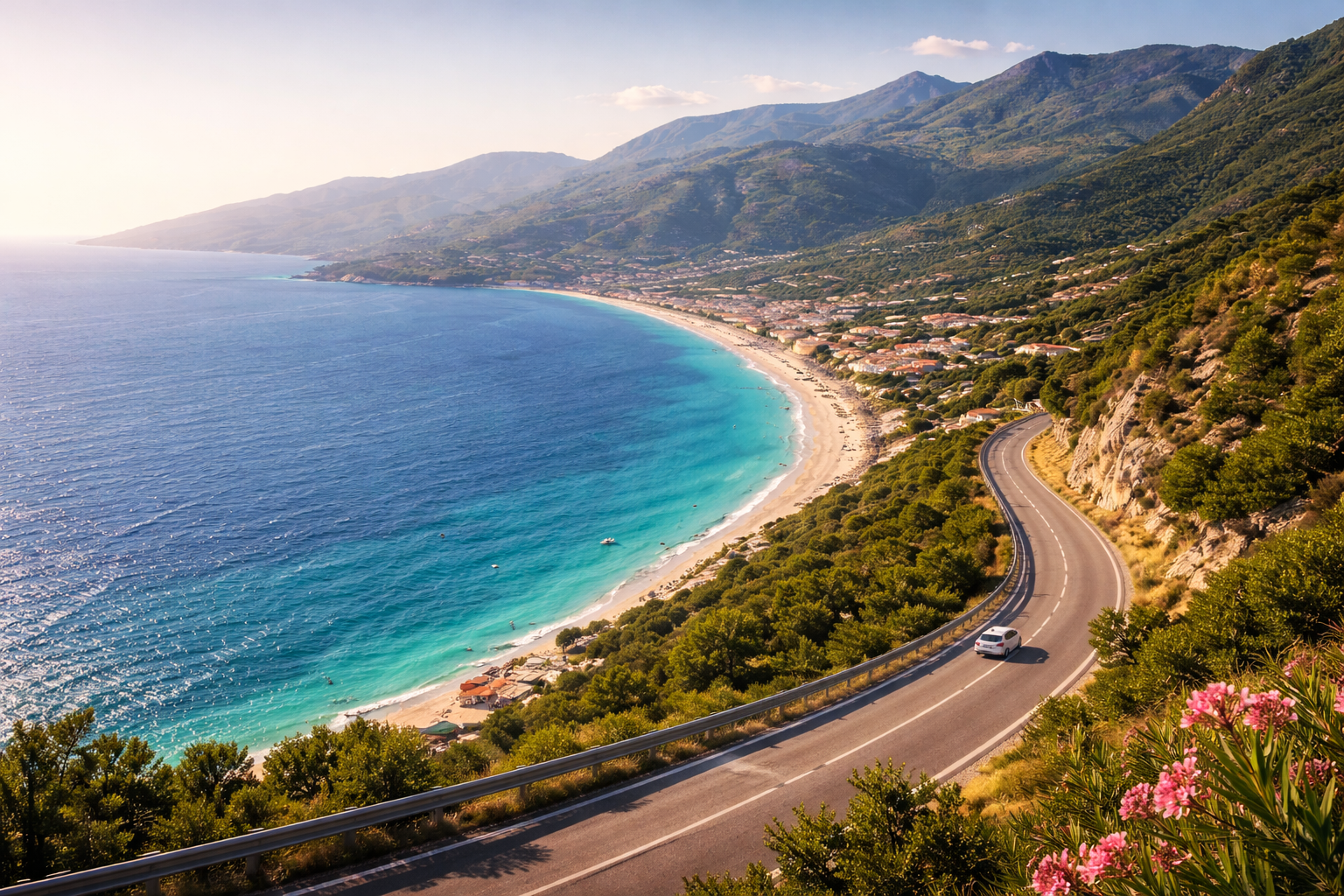
Everyone has already told you about Croatia. Santorini. The Amalfi Coast. The Albanian Riviera is what those places were before the Instagram hordes arrived, the prices tripled, and the sunbeds outnumbered the locals.
The Albanian Riviera stretches along the Ionian Sea from Vlorë in the north to Sarandë in the south. It is one of the most beautiful and still-affordable coastlines in Europe. The water is clearer than the Greek islands. White-pebble beaches back up against olive groves and limestone mountains. The seaside villages are only just beginning to be discovered by international tourism.
The window is closing. Albania went from 6.4 million international arrivals in 2019 to 12.47 million in 2025, nearly double in six years. Go now, before the prices catch up to the beauty.
Getting There
There are two main ways to reach the Albanian Riviera: fly into Tirana, or take the ferry from Corfu to Sarandë.
The Corfu route is the slicker play if you are coming from Western Europe. Corfu International Airport (CFU) has dozens of daily flights from European cities, with budget routes on Ryanair, Wizz Air, TUI, and easyJet. After landing, take a 20-minute ride to the Port of Corfu and board the ferry to Sarandë. Two options: the 30-minute speedboat or the 70-minute regular ferry, ranging from €20 to €50 depending on the season.
Via Tirana makes more sense if you want to see Albania properly. Tirana International Airport is well connected from most European cities, and the drive south to the Riviera takes around four to five hours. Stop in Berat or Gjirokastër along the way and turn the trip into a wider Albanian itinerary. The bus from Tirana to Sarandë costs around $20 USD and takes five hours. Schedules are loose. When the bus is full, it leaves.
Getting Around
Rent a car. There is no better advice for the Albanian Riviera. A hire car gives you the freedom to stop at viewpoints, explore small villages, and reach beaches you would never find otherwise. Book through Rentalcars. Rates start at around €20 per day. That is a reasonable price for the access it buys.
Driving in Albania can be slow but rewarding. Expect steep bends, goats on the road, and ridiculous views.
Local buses connect all the Riviera towns but they are basic, cash-only, and timetables change seasonally. Use GjirafaTravel to buy bus tickets online from Sarandë heading north, and the public bus for cheap rides between Sarandë and Ksamil.
Taxis are pricey. Expect €30–40 from Sarandë to Ksamil in summer 2025. Meters are required by law. Most drivers ignore that law.
When to Go
The sweet spot is May to June and September. July and August are peak months, especially in Ksamil and Sarandë. June and early September are the right calls for fewer crowds and lower prices. August is brutal. Temperatures sometimes approach 40°C and the beaches are packed. Plan for April to June or September to mid-October if you have any flexibility.
The Coastal Route: Town by Town

Vlorë and the Llogara Pass
Vlorë is the northern gateway, but the real drama starts just south of it. At 1,027 meters above sea level, the Llogara Pass road climbs through the Ceraunian Mountains in a series of hairpin turns and cuts through dense pine forest. Then it opens up to one of the most jaw-dropping panoramas in the Mediterranean. The entire Ionian coastline lays out below. Turquoise water stretches to the horizon. On clear days, Corfu floats in the distance. It is the single most dramatic road in Albania, and driving it is a highlight of any Riviera trip.
There is now a Llogara Bypass Tunnel. It cuts the journey from Vlorë to Palasë from 45 minutes of winding roads down to about five to seven minutes. Do not take it. Since the tunnel opened, traffic on the pass road has decreased noticeably. The scenic route is better, not worse.
The Observation Deck is the most popular stop on Llogara Pass, with the best open view of the Riviera, including Palasë Beach, Dhërmi, and the full sweep of the Ionian Sea. Stop there, buy a coffee, and accept that you are not in a hurry anymore.
Dhërmi
Dhërmi is the most social town on the Riviera. The beach stretches for about two kilometers of white pebbles and clear blue water. The town above the beach is quieter, with narrow stone lanes, blue-shuttered houses, and long views south toward Himarë.
Dhërmi is hugely popular for music festivals. If you love house, techno, or electronic music, a visit here in summer is essential. If that is not your scene, walk or drive up to the old village above the beach: all narrow lanes, blue-shuttered houses, and views stretching for miles.
Himarë
Himarë is the most authentically Albanian town on the Riviera. It has a real year-round population, a functioning old town, and a harbor that still belongs to the locals. The beach at Spile is one of the best on the coast: long, pebbly, and calm enough for swimming even when the sea is choppy further north.
Himarë is also the best base for exploring the central Riviera. You are within 30 minutes of Gjipe Beach to the north, Jale to the north, and Palasë and Dhërmi further up. Boat tours to Karaburun Peninsula and Sazan Island depart from Vlorë and take you around sea caves, abandoned military ruins, and beaches only accessible by water. Book through GetYourGuide.
Ksamil
Ksamil is the postcard. Four small islands just offshore, water the color of a swimming pool, and the kind of beach that stops people mid-sentence when they see it for the first time. It is also, in August, absolutely overrun.
Fair warning. Ksamil has gotten extremely busy in recent summers. Visit early morning or in shoulder season (May, June, September) to avoid the crowds. The three islands just offshore are reachable by a short swim or a rented paddleboat. The fourth, Ksamilit Island, requires a boat.
Where to Stay
Budget travelers are well served throughout the Riviera. Sarandë has the widest selection of hostels, with options from around $20–30 per night. Search and book on Hostelworld. Ksamil has guesthouses and summer rentals, often managed by local families at similar price points. In Himarë and Jale, eco-lodges and camping spots offer a more nature-immersed experience for less.
Mid-range travelers will find beachfront hotels running $50–120 per night across the Riviera, significantly higher in peak August. The design and quality have improved markedly in recent years, and several properties genuinely compete with equivalents in Croatia or Greece at half the price.
The justified splurge is Miamar Hotel in Himarë. Perched directly above the sea with an infinity pool, panoramic Ionian views, and rooms that would cost three times as much anywhere further west in the Mediterranean, Miamar is the rare case where spending more is simply the right call. Rates hover around $150–200 per night in shoulder season.
Miamar is the rare case where spending more is simply the right call: rooms that would cost three times as much anywhere further west in the Mediterranean.
What to Do
Butrint National Park
Butrint is a UNESCO World Heritage site covering 29 square kilometers south of Sarandë. Expect ancient Greek, Roman, Byzantine, and Venetian ruins spread across a wooded peninsula above a lagoon. Entry is around $11–12 USD. It is a 30-minute drive from Sarandë. Go in the morning before the tour groups arrive. Book tickets in advance through GetYourGuide to avoid the queue.
The Blue Eye (Syri i Kaltër)
The Blue Eye is a natural spring about 25 kilometers east of Sarandë, where water wells up from an unknown depth at a constant 10°C. The color is otherworldly. A disc of deep, saturated blue surrounded by pale turquoise, set inside a forested gorge. Entry is around $0.60 USD plus a parking fee. Go early. By 10am in summer, the access road can back up significantly.
Lëkurësi Castle Restaurant, Sarandë
It sits inside a 16th-century Ottoman fortress built by Sultan Suleiman the Magnificent in 1537. The setting is arguably the most dramatic in all of Sarandë. The castle sits atop a hill above the city. From there you can see the entire Sarandë bay, the beaches of Ksamil, Corfu on the horizon, and on clear days, the mountains of Greece. Few dining experiences in the Balkans match it for sheer drama. Go at sunset. Order the lamb.
Hidden Gem: Gjipe Beach

Albania’s coastline has become increasingly celebrated for its water clarity and dramatic scenery, but even within the Albanian Riviera, Gjipe occupies a category of its own. Enclosed by the soaring cliffs of Gjipe Canyon, this white-pebble cove is one of the most visually striking beaches in Europe, and it remains genuinely remote.
To get there, you hike. A 2.5 km panoramic trail winds down toward the shore. The hike takes roughly 30 to 45 minutes and is quite exposed to the sun. Bring comfortable shoes, a hat, and plenty of water. The trek back up is no joke. Alternatively, boat services run from the small bay near Potami, a few kilometers north of Himarë, and from Himarë port itself during peak season.
Unlike most beaches on the Riviera, Gjipe has no beach bars, no sunbed rentals, and no infrastructure. Bring everything you need, including food and water. That is precisely the point.
Where to Eat and Drink
In the better seafood restaurants, skip the printed menu. Walk to the entrance and look at the daily catch displayed on ice. A waiter will point out what arrived that day, give the weight of each specimen, quote a per-kilogram price, and ask how you want it cooked. Sea bass and sea bream are the staples. Grilled whole, with lemon and olive oil, on a terrace above the water. This is the meal you will talk about when you get home.
Pizzeria Ksamil, Ksamil
This consistently top-rated Ksamil spot delivers on every front, with wood-fired pizza and a 4.9/5 rating across hundreds of reviews. It is the kind of place that is busier at lunch on a Tuesday than most restaurants are on a Saturday night. Arrive early or expect a wait.
Era Restaurant, Sarandë
Sitting in the Kodrra neighbourhood of Sarandë, Era is the go-to for traditional Albanian cooking. Tavë kosi (baked lamb with yogurt), grilled vegetables, and fresh bread. The portions are generous. The prices are absurd in the best possible way. Dinner for two with wine rarely exceeds $30.
Gyros and Souvlaki Street Food
The Greek influence bleeds across the water. Souvlaki stands are everywhere in Sarandë and Ksamil. The souvlaki is exceptional. Eat it on the street. Pay almost nothing. This is how you keep the daily food budget at $15.
What to Skip
The Albanian Riviera is absolutely worth visiting, but only if you do it right.
Avoid the peak summer months. In July and August, the main beaches are packed with sun loungers and beach club noise. Rows of sunbeds take over stretches of coast that would otherwise be genuinely beautiful. Visit in shoulder season instead, when the beaches are peaceful and the prices drop by 30–40%.
The Albanian Riviera is not the Maldives of Europe, despite how viral that claim has become. The water clarity is genuinely impressive. But the main beaches in high season are crowded, a handful of luxury resorts charge top-tier prices, and the remote, boat-access-only coves are the exception rather than the rule. It is not a tropical island paradise. It is something different and, in many ways, better: a real coastline, with real towns, that still feels earned.
Skip Sarandë’s waterfront promenade restaurants. They are overpriced, tourist-facing, and worse than almost anything a 10-minute walk inland will produce. The closer to the sea view, the worse the food-to-price ratio. Walk away from the water to eat.
Travel Tips
Albania uses the Albanian Lek (ALL). Cards are accepted in most hotels and larger restaurants, but beach bars, small guesthouses, and local buses are cash-only. Withdraw Lek from ATMs in Sarandë or Vlorë before heading to smaller towns. The exchange rate from USD or EUR is favorable and consistent.
Albanians are exceptionally hospitable. Accepting an offer of coffee or raki from a local is not a social obligation but a genuine pleasure. Refusing abruptly can read as rude. A simple “faleminderit” (thank you) goes further than you expect.
The SH8 coastal road is in good condition for most of its length but narrows dramatically in places. If you are driving a larger vehicle, slow down on the blind hairpin bends. Local drivers know the road better than you do and will let you know it.
Phone signal is strong throughout the Riviera on Albanian SIM cards. Vodafone Albania and ALBtelecom both offer tourist SIMs for around $5–10 with generous data allowances. Buy one at the airport or in Sarandë on arrival. Do not rely on roaming.
The sea is cleanest at Gjipe, Jale, and the northern Dhërmi coves. If water quality matters to you, those are your beaches. Sarandë’s town beach, by contrast, gets murky in high season and is not worth your time when Ksamil is 15 minutes away.
Frequently Asked Questions
Is the Albanian Riviera safe to visit?
Yes. Albania is one of the safer countries in the Balkans for tourists. Petty theft exists, as it does everywhere, but violent crime against visitors is rare. Standard precautions apply: do not leave valuables visible in a parked car, use hotel safes where available, and stay aware in crowded markets.
Do I need a visa to visit Albania?
Citizens of the EU, US, UK, Canada, and Australia do not need a visa for stays of up to 90 days. Albania is not in the Schengen Zone, so your Schengen days are not affected. Check current entry requirements with your embassy before travel, as policies can change.
How long should I spend on the Albanian Riviera?
Plan for at least four to six days. That gives you time to cover Sarandë, Himarë, and Ksamil, explore hidden beaches, and do a boat tour or two. A week is better. Ten days lets you extend inland to Gjirokastër or Berat and still not feel rushed on the coast.
What language is spoken and do locals speak English?
Albanian (Shqip) is the official language. Most people working in tourism speak English well. Learn hello (mirëdita), thank you (faleminderit), and goodbye (mirupafshim) in Albanian anyway. It goes a long way.
Can I use euros in Albania?
Euros are widely accepted in tourist areas, hotels, and larger restaurants. For markets, local buses, and small cafes, Lek is expected. Always carry some local currency. The exchange rate is roughly 100 ALL to €1, making mental arithmetic straightforward.
Budget Summary
| Expense | Budget | Mid-Range | Splurge |
|---|---|---|---|
| Accommodation (per night) | $20–30 (hostel/guesthouse) | $50–90 (hotel) | $150–200 (Miamar/beachfront) |
| Meals (per day) | $15–20 | $30–50 | $60–80 |
| Car rental (per day) | €20 (~$22) | €20 (~$22) | €20 (~$22) |
| Ferry Corfu–Sarandë (one way) | €20–25 (regular) | €40–50 (speedboat) | €40–50 (speedboat) |
| Butrint entry | $12 | $12 | $12 |
| Blue Eye entry | ~$1 | ~$1 | ~$1 |
| Karaburun boat tour | $30–50 | $30–50 | $30–50 |
| Estimated daily total | $50–70 | $100–140 | $200+ |
Planning a trip to the Albanian Riviera and want a second opinion on your itinerary? Write to us at hello@outofmanhattan.com.
Leave a Reply