
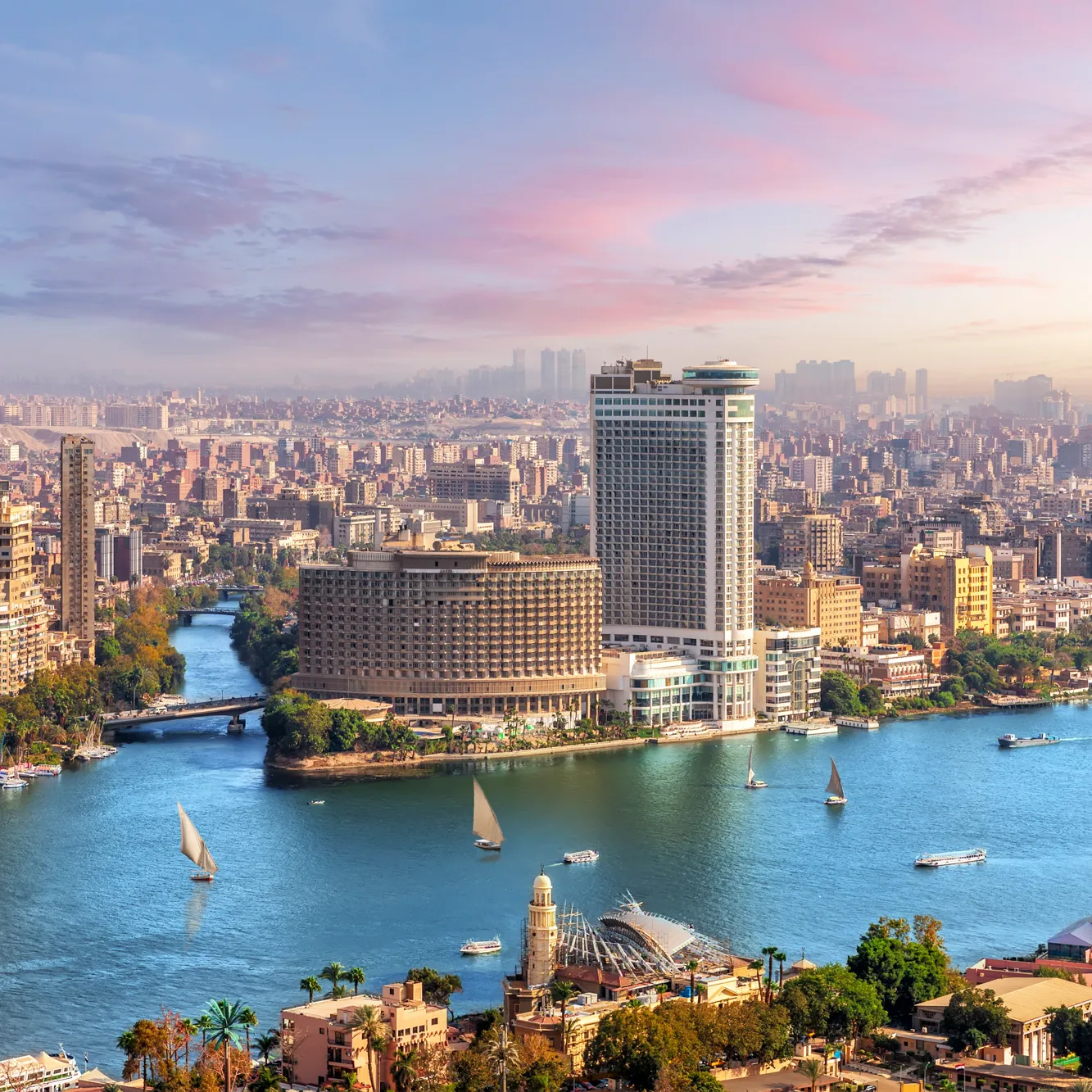
Most people treat Cairo like a gateway. They fly in, drive to Giza, take their photo with the Sphinx, and spend the rest of the trip somewhere else. That’s a mistake. Cairo is one of the oldest continuously inhabited cities on earth. It holds Coptic churches built on Roman fortresses, medieval Islamic streets untouched since the 14th century, the world’s greatest archaeological museum, and a food scene that eats loudly and without apology. Two days will not be enough. But two days done right will make you book a return.
Here is how to spend 48 hours properly.
Getting There
Cairo International Airport is located 11 miles from the city center. The drive downtown takes 40 to 60 minutes depending on traffic, which in Cairo can be relentless at any hour.
Uber and Careem both work well in Cairo. Their fixed, app-based fares are far less hassle than taxis with broken meters. An Uber from the airport to Downtown or Zamalek runs roughly 150 to 200 EGP (about $3 to $4 USD at current rates). Use it. Don’t negotiate with the unofficial drivers who swarm the arrivals hall.
Visa: You can get a renewable single-entry 30-day tourist visa on arrival at Egyptian airports for approximately $30 USD in exact change cash. The smarter move is to apply for an e-visa before departure at visa2egypt.gov.eg. The single-entry e-visa allows stays up to 30 days and typically processes within 5 to 7 business days. Skipping the visa queue at Cairo airport is worth every minute of advance admin.
Where to Stay
Cairo splits into distinct zones. Downtown puts you near the Egyptian Museum and the metro. Zamalek, the island in the Nile, is quieter and full of good restaurants. Giza puts you steps from the pyramids but 45 minutes from everywhere else. For 48 hours, Zamalek or Downtown is the right call. Save Giza for a longer trip.
Budget: Hostels and budget hotels run $20 to $40 per night on Hostelworld, and mid-range hotels cost $40 to $80. The Valencia Hotel in Downtown Cairo sits steps from Talaat Harb Street, includes breakfast, and holds a 9.2 review rating. It is a clean, central base with nothing to complain about.
Mid-range: For a Nile-adjacent stay, Kempinski Nile Hotel in Garden City works well. Rates start around $150 per night. The rooftop pool faces the river and the restaurant does not require you to leave the building for a good meal.
The Justified Splurge: Marriott Mena House in Giza is not a hotel. It’s an argument. Built in 1869 as a hunting lodge, it became a grand hotel in 1886 and has hosted Winston Churchill, Agatha Christie, and Frank Sinatra. Book the Deluxe Pyramid Premium Room. It comes with a private balcony facing the Great Pyramid. Rates start around $200 per night. If the pyramids are why you came, wake up with them framed outside your window at least once.
In Cairo, the ceilings often tell better stories than the streets.
Day One: The Giza Plateau and the Grand Egyptian Museum

Start at the pyramids. This is not negotiable. Go early.
Arrive before 8:30 AM. The site fills fast during peak season, and the Egyptian midday sun is not something you want to test your stamina against. A new bus system inside the Giza Plateau lets you enter at the new main gate or the old Sphinx gate and take free buses between sites on the plateau. You do not need a guide, but having one transforms the experience. Budget $30 to $60 for a licensed guide booked through your hotel or via GetYourGuide.
One warning: people will offer to take photos of you “for free.” After taking mediocre pictures, they will pressure you into paying. Decline politely.
The Grand Egyptian Museum
After the plateau, walk or take the short ride to the Grand Egyptian Museum (GEM), connected to the Giza Plateau via a new bridge. This is the other reason you came.
The GEM fully opened on November 4, 2025. Foreign adult tickets cost EGP 1,450 (around $30 USD) and must be booked online at visit-gem.com before you arrive. No tickets are sold on-site. Book your timed entry slot before you leave home. During peak season, October through April, popular slots sell out days or weeks ahead.
The GEM now holds over 100,000 artifacts spanning 7,000 years of Egyptian history. All 5,300 objects from Tutankhamun’s tomb are displayed together here for the first time in history. This includes the golden death mask, sarcophagi, golden shrines, chariots, beds, and thousands of smaller objects. The majority had never been publicly displayed before the GEM opening.
Plan at least 4 to 6 hours. Wear comfortable shoes. Arrive at your booked time slot. The Tutankhamun galleries, the Grand Staircase, and Khufu’s Solar Boat are the three things you cannot skip.
Dinner: Andrea Restaurant
After a full day at Giza, don’t battle traffic into Downtown. Andrea is a Cairo institution, open-air, close to the Pyramids, and built around one thing: grilled chicken done right. Order the chicken, the baladi bread, and something cold. Mains run 150 to 350 EGP. Pay cash.
Day Two: Islamic Cairo, Coptic Cairo, and Khan el-Khalili

This is the Cairo that most tourists miss. It is also the best Cairo.
Morning: Coptic Cairo
Take an Uber to Mar Girgis, or ride the metro directly to the Mar Girgis station. The stop sits inside the complex, steps from the main attractions.
The centerpiece is the Hanging Church. Known in Arabic as al-Mu’allaqa, meaning “the suspended,” it is one of the oldest churches in the world. It was built in the late 7th century CE over the southern gatehouse of the Roman fortress of Babylon. The nave is literally suspended over the fortress gateway’s two ancient Roman towers, which is how it got its name. The nave ceiling is divided into 29 panels, each framing a carved wooden arch in ebony, cedar, and ivory. It is one of the most elaborate wooden ceilings in any Egyptian church. A marble pulpit stands in the nave, supported on thirteen slender columns representing Christ and the twelve apostles. One column is slightly darker to represent Judas. Entry is free, though a small donation is appreciated.
Look at the glass panels in the floor. They reveal the Roman fortress towers below, a direct view down through 2,000 years of history stacked underneath the church.
From the Hanging Church, walk to the adjacent Coptic Museum and spend an hour with the artifacts removed from the church over the centuries. Then continue to the Ben Ezra Synagogue, one of the oldest in Egypt.
Midday: Lunch and the Koshari Question
You need to eat koshari before you leave Cairo. It is Egypt’s national dish and one of the great street food experiences on earth. Koshari is lentils, rice, pasta, chickpeas, crispy onions, and a spicy tomato sauce, served in layers, hearty and deeply satisfying. Koshary Abou Tarek is the institution. Bring cash. A full bowl costs under 50 EGP.
Zooba in Zamalek takes Egyptian street food seriously. The taameya (Egyptian falafel), ful medames (mashed fava beans), and spicy pickles are all worth ordering. Plates run 80 to 150 EGP.
Afternoon: Al-Muizz Street and Khan el-Khalili
Take an Uber to Islamic Cairo. Walk north on Al-Muizz Street. Do not rush.
Al-Muizz Street has been a commercial and religious artery of Cairo since the 10th century. It runs for 1 kilometer, flanked on both sides by intact medieval Islamic architecture: mosques, madrasas, sabils, palaces, and covered markets. It was restored in the early 2000s and closed to vehicle traffic. In the evening, lit from beneath, with the call to prayer echoing from the minarets above, it ranks among the most beautiful walks in Africa. Come back after 5 PM. The change from afternoon to evening is total.
Khan el-Khalili sits at the southern end of Al-Muizz. Built in 1382 during the Mamluk period, it has witnessed the entire modern history of Egypt. It is also notorious for aggressive vendors, and roughly 60% of items on sale are not made in Egypt. Walk deeper into the market before spending anything.
The hidden gem is the gold souk. The Goldsmiths’ Quarter, a concentrated network of jewellers inside and adjacent to Khan el-Khalili, is one of the most honest purchasing environments in the entire market. Gold is sold by weight at the daily market rate, which you can verify instantly on your phone. The making charge is where negotiation happens. The signature Cairo souvenir is the cartouche: your name or a chosen word rendered in hieroglyphics in a gold or silver oval pendant, engraved on the spot while you wait. A good cartouche from a reputable jeweller takes 30 to 60 minutes to complete. Silver cartouches start at approximately 800 to 1,500 EGP depending on size.
When you need to sit, find El-Fishawy. It opened in 1797, one year before Napoleon’s invasion of Egypt. As of 2026, it has been serving tea, coffee, and shisha continuously for 229 years. Order the mint tea and watch the alley move around you.
Evening: Dinner on the Nile
End the trip properly. Sequoia sits at the tip of Zamalek island and combines Mediterranean food with serious Nile views. The open-air, tented layout works well for sunset. Reserve in advance. Budget $25 to $50 per person.
For something more Egyptian and less scene-driven, Abou El Sid delivers on the classics. Order the fatta bel-bamya, the kofta, and whatever is coming off the charcoal. The space is all high ceilings, wooden beams, and good noise. Dinner for two runs 400 to 700 EGP.
What to Skip
The Sound and Light Show at the Pyramids. It sounds better than it is. The narration is dated, the production feels like 1985, and the money is better spent on an extra hour at the GEM.
The felucca rides on the Nile near Downtown. Tourist-facing, overpriced for what they are, and the hawking from the banks never stops. If you want the Nile experience, Sequoia gives you that with a better meal attached.
The old Egyptian Museum at Tahrir Square, for this particular 48-hour trip. The GEM has made the Tahrir museum largely redundant for most visitors. Most objects there have no labels or placards, so without a guide it is a frustrating exercise in guessing. If you have more days, visit it with a guide. On 48 hours, skip it and bank the time for Al-Muizz Street.
Getting Around
Uber and Careem are the correct answer for almost every journey. The Cairo metro is clean and cheap for north-south routes, though crowded during peak hours. Walking is possible in Zamalek, Coptic Cairo, and Islamic Cairo but impractical between neighborhoods. The city is vast and the traffic is serious.

Cairo Travel Tips
Book the GEM before anything else. The Grand Egyptian Museum moved to online-only ticketing in December 2025. Walk-in purchases are no longer available. Book at visit-gem.com.
Carry Egyptian pounds in cash. It remains the only option at many of Cairo’s best local spots. Koshary Abou Tarek and similar neighborhood institutions are cash-only. Having small bills prevents awkward situations.
Dress for religious sites. Cover shoulders and knees. Bring a scarf for mosques. Comfortable, closed shoes matter more than you expect after a full day on stone floors.
The best season runs October through May. Temperatures are manageable and the sites are at their best. Summer temperatures regularly exceed 100°F.
Skip Friday mornings at Khan el-Khalili. Many shops stay closed until around 3:00 PM.
Do not photograph military buildings. It is illegal to photograph police stations, military barracks, and certain other sensitive public buildings.
FAQs
Do I need a visa to visit Egypt?
Most international visitors require a tourist visa. This applies to travelers from the United States, United Kingdom, European Union, and Australia. You can get a single-entry 30-day tourist visa on arrival at Egyptian airports for approximately $30 USD in exact change cash. Applying online in advance at visa2egypt.gov.eg is faster and avoids airport queues.
Is Cairo safe for tourists?
Cairo is safe. Millions of people visit every year without incident. Crime against foreigners is mostly opportunistic: pickpocketing and bag snatching in crowded markets. Use Uber rather than street taxis, keep your phone out of sight in the souqs, and pay attention to your surroundings.
Do I need a guide for the Pyramids and the GEM?
You don’t need one, but a licensed local guide significantly improves both experiences. At the GEM, the collection is large enough that a guide helps you prioritize. At the pyramids, a guide handles touts and gives the site its historical depth. Budget $30 to $60 for each.
What is the best neighborhood to stay in for a short Cairo trip?
Downtown Cairo puts you closer to the metro. Zamalek is calmer and better for eating well in the evenings. Both work for 48 hours. Avoid Giza unless Mena House is the specific reason you’re there.
How far in advance should I book GEM tickets?
During peak season, October through April, popular slots sell out days or weeks ahead. Book the moment your Egypt dates are confirmed. That is not overcautious. It is necessary.
Budget Summary
| Category | Low End | High End | Notes |
|---|---|---|---|
| Accommodation (per night) | $20 | $200 | Hostel/budget hotel to Mena House splurge |
| GEM Entry | $30 | $30 | EGP 1,450; book online at visit-gem.com |
| Pyramids + Guide | $30 | $60 | Licensed guide via hotel or GetYourGuide |
| Airport Transfer (Uber) | $3 | $4 | 150–200 EGP one way |
| Koshari (Koshary Abou Tarek) | $1 | $1 | Under 50 EGP per bowl |
| Lunch at Zooba | $2 | $3 | 80–150 EGP per plate |
| Dinner at Andrea | $3 | $7 | 150–350 EGP per person |
| Dinner at Abou El Sid (for two) | $8 | $14 | 400–700 EGP |
| Dinner at Sequoia | $25 | $50 | Per person; reserve ahead |
| Visa on Arrival / E-Visa | $30 | $30 | Cash exact change for on arrival |
| Cartouche souvenir (silver) | $16 | $30 | 800–1,500 EGP |
| Estimated Daily Total (budget) | ~$75 | ~$120 | Excluding accommodation and splurge |
Have questions about Cairo or anywhere else in Egypt? Write to us at hello@outofmanhattan.com — we answer every email.
Leave a Reply